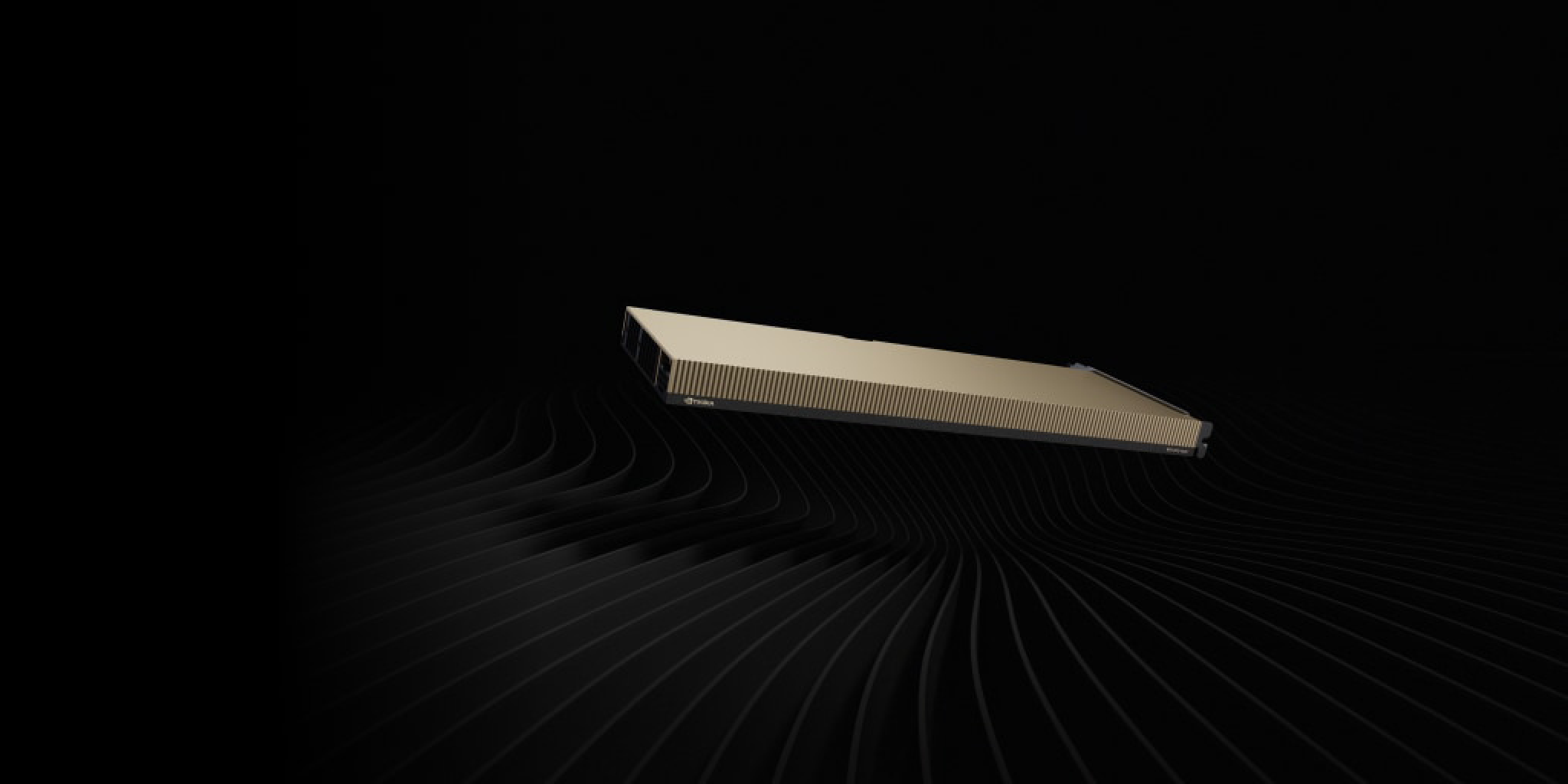
The RTX PRO 4500 Server Edition is NVIDIA's latest entry in their professional workstation and server GPU lineup, built on the Blackwell architecture. It targets dense compute deployments where rack space and power budgets are at a premium — delivering a respectable slice of Blackwell's tensor compute capabilities within a strict 165 W, single-slot passive form factor.
Architecture & Compute
The
RTX PRO 4500 Server Edition carries 10,496 CUDA cores and 82 RT Cores, placing it a step below the full GB202 die configurations seen in the flagship Blackwell parts. Despite that, the Tensor Core throughput is substantial: FP4 peaks at 1.6 PFLOPS, FP8 at 811 TFLOPS, and FP16/BF16 at 406 TFLOPS. TF32 lands at 203 TFLOPS, with FP32 scalar compute at 51 TFLOPS.
RT Core performance is rated at 154 TFLOPS peak, which remains relevant for professional visualization workloads running alongside inference tasks.
Memory
The card ships with 32 GB of GDDR7 across a 256-bit memory interface, delivering 800 GB/s of memory bandwidth. For a 165 W TDP card this is a strong result — GDDR7 at this density and bandwidth makes the PRO 4500 Server Edition well suited to large model inference, batch rendering, and memory-bound workloads that would previously require higher-wattage options.
MIG Support
The RTX PRO 4500 Server Edition supports Multi-Instance GPU partitioning, with up to 2 MIG instances at 16 GB each. This allows a single card to be split between two isolated workloads with dedicated memory allocations — useful in shared server environments or virtualized deployments where workload isolation is required.
Media Engine
NVIDIA equips the PRO 4500 with 3× NVENC and 3× NVDEC engines, reflecting its positioning in professional environments where hardware-accelerated video transcoding may run alongside compute workloads. This is the same media engine configuration found on higher-end Blackwell professional parts.
Security & Connectivity
Confidential Compute is supported, enabling hardware-level memory encryption and isolated execution environments — a feature increasingly required in enterprise and cloud-adjacent deployments handling sensitive data.
The card connects via PCIe 5.0 x16, providing up to 128 GB/s of bidirectional host bandwidth. This is especially relevant given the 800 GB/s memory bandwidth on-die — high-throughput data pipelines between host and GPU will benefit from the PCIe 5.0 interface over previous generations.
Thermal Design
The passive thermal solution means zero onboard noise and no moving parts, but it also means the card is entirely dependent on chassis airflow. It is not suited for open-air or desktop use without deliberate cooling provision. In 1U and 2U server platforms with front-to-back airflow, or in tower workstations with strong case fans, the passive design is straightforward to manage at 165 W.
See all the RTX PRO models
hereConclusion
The RTX PRO 4500 Server Edition is a focused product. It brings Blackwell Tensor Core performance, 32 GB GDDR7, MIG support, and Confidential Compute into a 165 W, single-slot passive package — a combination that makes sense for dense server deployments prioritising compute density over peak throughput. It is not the fastest Blackwell card available, but within its power and space envelope, it offers a well-rounded specification for inference, professional visualization, and mixed workloads.
The creator and owner of Hashrate.no goes by the alias r0ver2. With years of hands-on experience working with GPU hardware, he started building and configuring his own systems in 2017 — gradually scaling from a home setup to a larger multi-GPU operation, gaining deep technical knowledge of hardware management, power delivery, thermals, and system stability along the way.
Last updated: March 17, 2026












 MEXC Exchange
 MinerBros
 Jingle mining
 gpus.net
 gpus.no
 gpus.se
 gpus.dk